

BrandValue is easy to misuse as a vanity headline: "We're top N." Planning needs something sharper—trajectory, cohort, and implication.
A trophy rank with a soft trajectory is not a growth mandate.
This guide shows how to fold platform-backed value trends into quarterly planning without turning finance and brand into rival religions.
Read value as a time series
In a planning packet, always show:
- Absolute value level (with units / methodology note)
- Rank movement vs prior periods
- Industry / cohort context
- One sentence on why the trend might be real (mix, geography, perception)
A flat high value and a rising mid value demand different bets.
Three planning postures
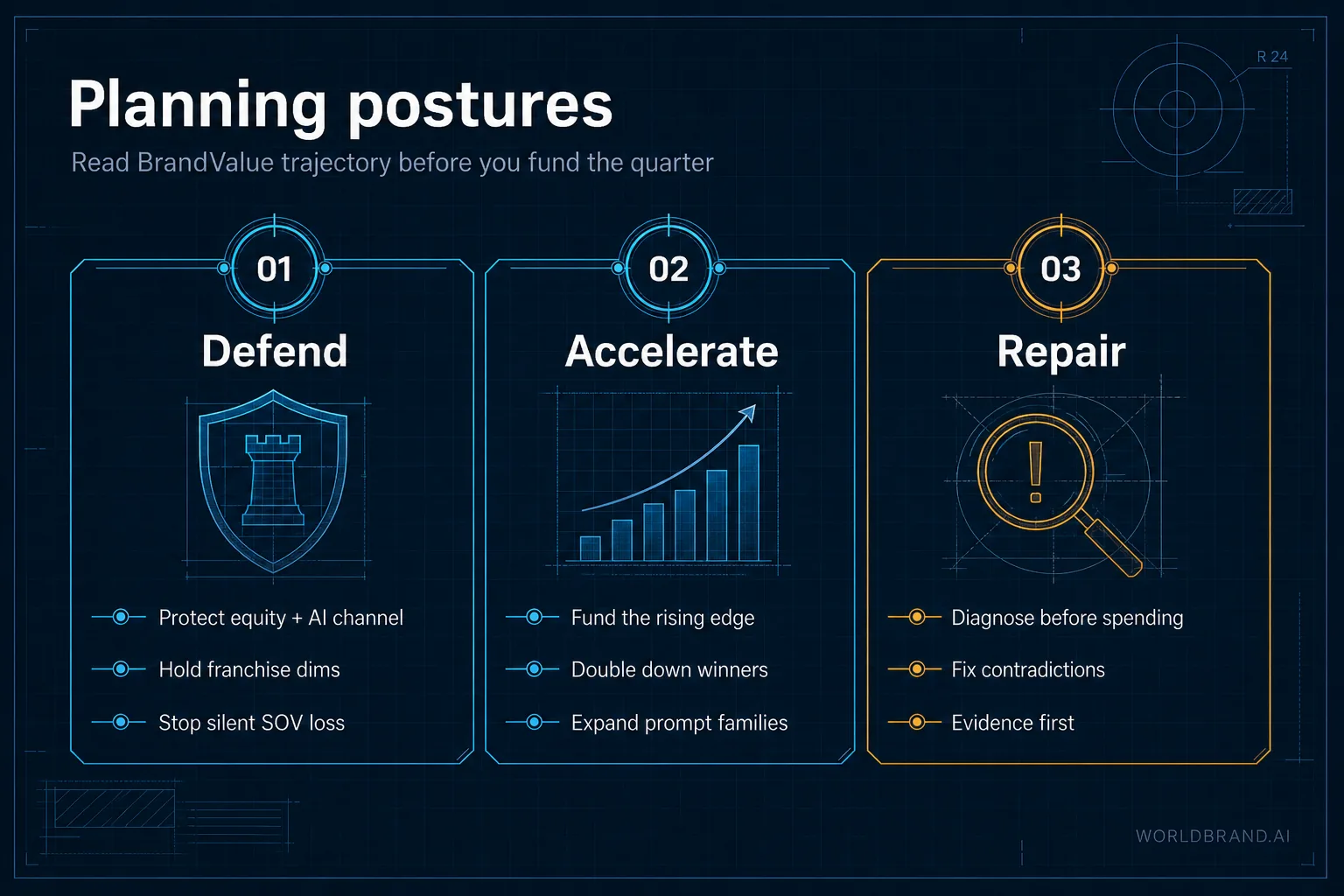
Defend
High value, stable rank, soft AI visibility → fund evidence and answer-channel defense so equity is not quietly eroded in AI shortlists (BrandAEO).
Accelerate
Rising value + rising momentum signals (BrandSight) → double down on the categories and geographies driving the trend; lock prompt sets that monitor those segments.
Repair
Falling rank or volatile value → stop campaign inflation; diagnose structural gaps and public-fact conflicts in Brand Hub before spending on awareness.
Pair value with the other scoreboards
| Question | Lens |
|---|---|
| Are we valuable? | BrandValue |
| Are we well-built? | BrandSight |
| Are we chosen in answers? | BrandAEO |
| Are we knowable? | BrandWiki / Hub facts |
Planning that only watches value will miss answer-channel decay. Planning that only watches AI SOV will miss equity gravity. For the full divergence playbook, see Brand Value vs. AI Share of Voice.
Budget implications by posture
| Posture | Fund more of | Fund less of |
|---|---|---|
| Defend | Citeable repairs, prompt monitoring, franchise dimensions | Speculative category expansion |
| Accelerate | Segment-specific evidence + demand capture | Generic awareness without measurement |
| Repair | Fact ownership, contradiction cleanup, diagnostics | Launch theater and vanity SOV stunts |
Example planning packet (one slide)
Posture: Defend
Value: Rank stable in cohort; absolute value flat QoQ
Sight: Leadership strong; globalization soft
AEO: Category SOV flat; "expensive" framing up on comparison prompts
Bets: (1) pricing FAQ repair, (2) freeze prompt set v3.2, (3) no net-new category campaign until framing ticket closes
That slide beats twelve charts with no decision.
A quarterly agenda (60 minutes)
- Value trend + cohort (10)
- Sight shape changes (10)
- AI SOV / framing on locked prompts (15)
- Bet selection: defend / accelerate / repair (15)
- Owners + budget lines (10)
Leave with three artifacts: posture sentence, top three tickets, prompt-set version ID. If you leave with only a chart pack, you held a meeting—not a planning session. Wire the tickets into the weekly rhythm from From Snapshot to Operating Rhythm.
Anti-patterns
| Anti-pattern | Why it fails |
|---|---|
| Using BrandValue rank as a campaign KPI | Rank without trajectory hides decay in answer channels |
| Funding "awareness" while citation conflicts remain open | Equity erodes in AI shortlists while spend inflates |
| Changing the AEO prompt set mid-quarter to manufacture a win | Destroys trend integrity; confuses planning signals |
| Separate finance and brand decks with no shared peer set | Two truths, zero decisions |
FAQ
Who should convene the quarterly BrandValue planning session?
The CMO or planning lead runs the 60-minute agenda with brand ops, finance, and an AEO representative in the room—not a floating strategy workshop. Finance brings cohort context; brand ops brings tickets; AEO brings locked-prompt signals. Nobody leaves without a posture sentence and three owned bets.
What should we refuse to fund in a repair posture?
Pause vanity awareness, launch theater, and mid-quarter prompt-set edits. Repair means diagnosing contradictions and missing evidence first—re-measure on the locked set before scaling campaigns. Funding "SOV stunts" during repair is how teams buy green charts and lose recommendation reality.
How do finance and brand avoid rival religions on the same number?
Share one peer set, one prompt-set version ID, and one planning slide format. BrandValue sets posture; BrandSight and BrandAEO verify it. If the decks never share definitions, you will get two quarterly truths and zero budget clarity.
What artifacts prove planning happened—not just chart review?
A posture sentence (defend / accelerate / repair), top three tickets with owners and due dates, and a prompt-set version ID. A chart pack alone is a meeting; those three artifacts are a plan.
Where BrandAI fits
- BrandValue — trajectory and cohort context for posture selection
- BrandSight — structural shape that explains value–visibility divergence
- BrandAEO — locked-prompt SOV and framing signals for answer-channel bets
- Brand Hub / BrandWiki — fact ownership and reference hygiene during repair
BrandValue is a planning instrument when you treat it as trajectory-in-context. Use it to choose posture, then verify with structural and AI-visibility lenses so the plan funds reality—not last year's trophy.