
Most "ask an AI about our brand" sessions fail for a boring reason: the human asks a vague question, the model invents a fluent answer, and everyone mistakes fluency for diligence.
BrandAI is built for brand intelligence work—briefing, comparison, scenario framing—connected to platform products rather than a random tab. It still rewards good questions.
The workflow that works
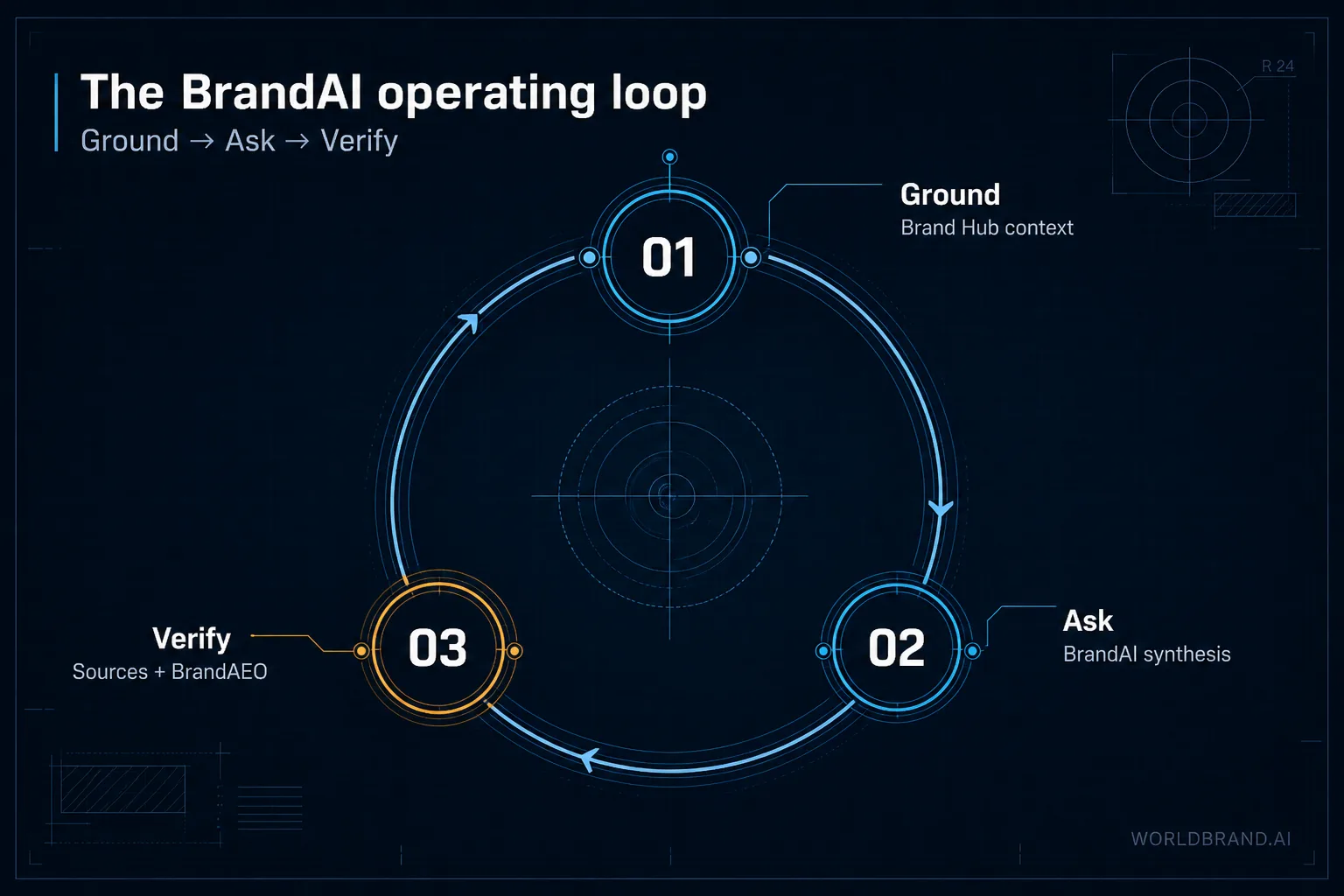
Use a three-step loop:
- Ground — pull context from Brand Hub (profile, value, sight, wiki-style facts, AEO snapshots when available)
- Ask — use BrandAI to synthesize, contrast, or draft
- Verify — send contested claims back to sources; check answer-channel reality in BrandAEO when the topic is visibility
Skip step 1 and you get generic strategy theater. Skip step 3 and you ship hallucinations into decks.
Question patterns that produce leverage
Positioning briefs
Weak: "Tell me about Brand X."
Stronger:
- Summarize how Brand X is positioned vs [peer A, peer B] for [buyer job], using only corroboratable public facts.
- List five claims we make that competitors also make—and two claims that appear distinctive.
- What category nouns should we use in unbranded prompts if we want models to retrieve us?
Competitive stress tests
- If an assistant must recommend three options for [scenario], which peers are structurally favored and why?
- Where does our BrandSight profile (leadership / momentum / globalization) predict answer-channel weakness?
- Draft the hostile one-paragraph description a model might produce—and the factual repairs that would prevent it.
Executive artifacts
- Turn this Hub snapshot into a one-page board brief: equity trend, structural scores, AI visibility risk.
- Write three talking points for sales when customers ask "how do you compare to [peer]?"
- Produce a 90-day evidence-repair plan ordered by impact on category prompts.
Content and AEO assist
- Propose ten unbranded category prompts for [segment] that should enter our BrandAEO set.
- Which public pages need citeable rewrites first if we want comparison prompts to stop framing us as legacy?
- Outline a comparison page structure that is extractable without hype.
Guardrails (non-negotiable)
Do not treat BrandAI as a citation. It is a drafting and reasoning surface. Final facts need sources.
Name the decision. Every session should end with a decision, a draft owner, or a measurement next step—not "interesting."
Keep peers honest. Inflated or missing peers poison both Hub reading and AEO prompt design.
Separate creative from corroboration. BrandAI can ideate campaigns. It cannot invent third-party consensus. Plan earned and owned evidence separately.
Show your work. Ask BrandAI to list which Hub fields or snapshots it relied on. If it cannot, you were chatting, not briefing.
Example session (30 minutes)
- Open the brand in Brand Hub; skim value trend + sight shape + any AEO alert.
- In BrandAI: "Draft a two-audience brief (investor vs buyer) from this profile; flag missing facts."
- Patch missing facts via wiki/docs owners.
- In BrandAEO: confirm whether unbranded prompts already reflect the story you want.
- File tickets. Stop.
Anti-patterns
- Starting in BrandAI with no Hub brand open
- Asking for "a brand strategy" without peers, segment, or decision
- Pasting BrandAI prose into a board deck without source checks
- Using BrandAI to rewrite prompts after a bad SOV week instead of repairing evidence
FAQ
Who should run BrandAI sessions?
A strategy or brand-ops lead who already owns the decision—not whoever opened the chat tab first. They open Hub, name peers and the decision, and refuse to end without a ticket or measurement step.
How do we attach BrandAI to work we already do?
Slot it into existing brief cycles: Hub readout first, BrandAI for synthesis and contrast, then source checks and BrandAEO when the topic touches answer channels. Do not spin up a separate "AI brainstorming hour" with no downstream owner.
What is the most common failure mode?
Treating fluent prose as diligence—especially pasting BrandAI output into decks without Hub field citations or AEO verification on visibility claims.
What should NOT go into a BrandAI brief?
Open-ended "tell me about our brand" prompts, inflated peer sets, and requests to invent third-party consensus. If there is no decision, peer frame, or verify step, you are chatting—not briefing.
Where BrandAI sits in the stack
| Need | Product |
|---|---|
| Conversational synthesis & briefs | BrandAI |
| Unified brand investigation | Brand Hub |
| AI answer measurement | BrandAEO |
| Structural brand scoring | BrandSight |
| Valuation & rank history | BrandValue |
| Encyclopedic reading | BrandWiki |
Bottom line
Better brand questions are specific, peer-aware, decision-linked, and grounded in Hub evidence. BrandAI multiplies that discipline. It cannot replace it.
Ask like an analyst. Verify like an editor. Measure like an operator. That is how BrandAI turns chat into brand advantage.