

Brand work rarely fails because teams lack tools. It fails because the tools disagree in different tabs.
Valuation lives in one export. Structural scores live in another. The "official" story lives in a wiki draft. AI visibility lives in a screenshot thread. By the time leadership asks a simple question—who are we to the market right now?—the room is holding four partial answers.
Brand Hub exists to end that fragmentation: one search, one brand surface, then deep links into platform tools when you need to go further.
The fragmentation tax
Every extra system creates translation work:
| Function | Speaks in | Without Hub |
|---|---|---|
| Finance | Value and rank (BrandValue) | Optimizes locally on equity exports |
| Brand strategy | Dimensions (BrandSight) | Decks that ignore AI-channel framing |
| Comms | Reference facts (BrandWiki) | Wiki drafts disconnected from mention data |
| Growth | Answer-engine mentions (BrandAEO) | Screenshot threads that rediscover naming conflicts |
| Everyone else | Fluent summaries (BrandAI) | Summaries of a mess nobody verified |
Without a hub, each function optimizes locally. With a hub, the first job becomes shared diagnosis.
The tax shows up as duplicate research, conflicting decks, and AEO meetings that rediscover the same naming conflict every month.
Hub does not replace the labs—it stops you from pretending one lab is the whole brand.
What "one investigation" should include
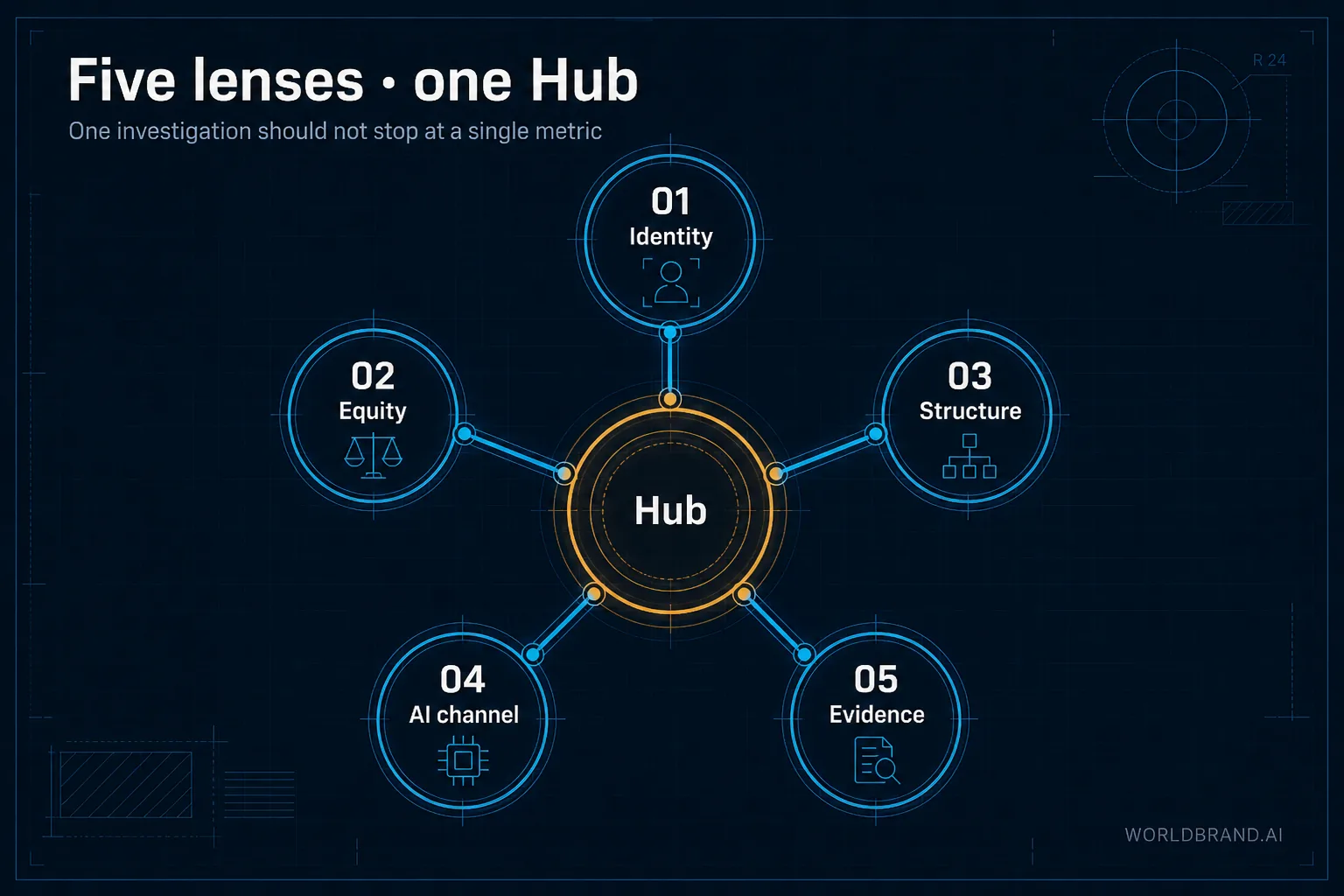
A serious brand investigation usually needs five lenses in the same sitting:
- Identity — names, category, geography, parentage
- Equity — value level and trajectory
- Structure — seven-dimension shape vs peers
- Narrative channel — how AI answers currently shortlist you
- Evidence hygiene — whether public facts can support the story
Hub is the reading room. Sister products are the labs.
If any lens is missing, write that gap down before you invent a strategy. "We have no AEO snapshot yet" is a better finding than a confident story built on three tabs and a gut feel.
How to use Hub without turning it into a portal graveyard
| Do | Do not |
|---|---|
| Start with a question, not a tour. "Why are we losing mid-market category prompts?" beats clicking every module. | Wander across modules without a decision question |
| Time-box the first pass. Fifteen minutes to shape the problem; then dive with intent. | Treat browsing as investigation |
| Write the one-sentence brief before you leave. | Hand off vibes without links or owners |
| Hand off with links + owners. Hub context should become tickets. | Compare multiple brands before the spine is clear |
| Refuse multi-brand wandering. One brand per investigation block. | Pretend one lab export is the whole brand |
Example investigation path
Question: "Why do assistants call us expensive on comparison prompts?"
- Hub identity — confirm category nouns and flagship offer
- BrandAEO — confirm the frame on locked comparison prompts
- BrandSight — check whether structural scores explain premium/complexity perceptions
- BrandWiki / owned pages — find the citeable pricing or packaging language models reuse
- Ticket — DRI, URL, success signal, re-measure date
That path is Hub doing its job: orchestration, not decoration.
Where Hub fits the weekly operating rhythm
Editorial, product, and brand-ops teams can treat Hub as the research desk behind BrandAI narratives: pull a brand, verify the spine, then publish claims you can defend in both human decks and machine answers.
On the weekly cadence from From Snapshot to Operating Rhythm, Hub is where diagnose happens before assign. BrandAI can help draft the brief—after Hub grounding, not instead of it.
FAQ
Who should own a Hub investigation session?
Whoever holds the decision question—brand ops, strategy, or agency lead—runs the fifteen-minute first pass and writes the one-sentence brief before anyone dives into a single module. Hub context must leave as tickets with owners, not as shared screen time.
How do we attach Hub to the weekly AEO rhythm?
Use Hub in the diagnose block: confirm identity and structural shape before you assign evidence repairs from BrandAEO. Do not run parallel "Hub tours" that never produce a ticket.
What is the portal-graveyard anti-pattern?
Clicking every module without a question, comparing multiple brands before the spine is clear, and handing off vibes instead of links + DRIs. If you cannot summarize what you learned in one sentence, you browsed—you did not investigate.
Is Brand Hub a replacement for BrandAEO?
No. Hub orchestrates context across lenses; BrandAEO measures answer-channel performance on locked prompts. Decisions need both—especially when structural scores explain why engines frame you as expensive, local-only, or incomplete.
Bottom line
Brand Hub is not another dashboard to decorate. It is the anti-fragmentation layer for Lab intelligence.
Search once. See the brand. Then go deep on purpose.